The City of Nanaimo is launching a new initiative that explores pre-zoning land in certain areas, to accelerate the delivery of social housing, by removing the requirements for a rezoning. This initiative has been identified as a Council priority action in the Integrated Action Plan (Priority Action #69).

This initiative responds to challenges non-profit housing providers have with the timelines associated with rezonings, impacting their ability to secure funding. By streamlining the approval process, this initiative helps projects move forward more quickly.

Project Update

Staff presented the draft development framework to the Governance and Priorities Committee (GPC) meeting on January 26, 2026. Click here to view the Staff Report and video.

A survey to gather feedback on the draft framework will begin on February 23 and run until March 15. Stay tuned!

Defining Social Housing

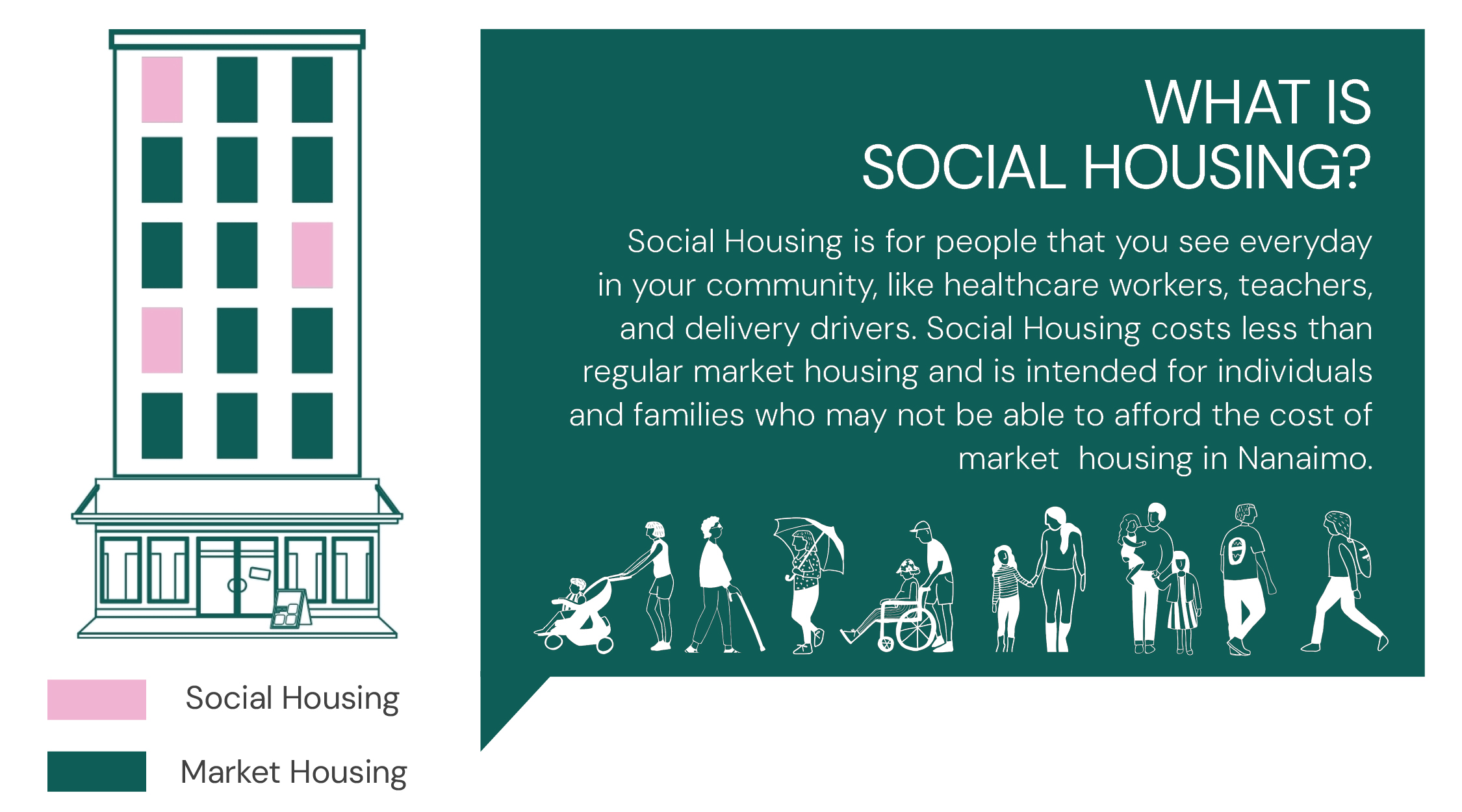
This initiative is proposing to pre-zone land to allow for the development of social housing. Social housing is defined as:

Illustration showing a 6 storey building with commercial on the ground floor and a mix of social and market housing units, On the right, the caption reads "What is Social Housing? Social housing is for individuals and families who live independently, and

Pre-Zoning for Social Housing Initiative

This initiative proposes to amend the Zoning Bylaw by introducing a new overlay of zoning regulation that would be applied to parcels with a Primary Urban Centre, Secondary Urban Centre, Mixed Use Corridor and Residential Corridor Future Land Use Designation per Schedule 2 of City Plan: Nanaimo ReImagined (Official Community Plan). The overlay would be a voluntary, incentive based option, that may be applied to parcels at the applicant’s request when social housing is provided. The overlay would included eligibility requirements and conditions that would need to be met to qualify for the pre-zoning.

Graphic showing key eligibility requirements. 1) 20% of units must be social housing; 2) The social housing units need to be secured for 60-years;  and 3) The development can be a mix of social housing, market housing and commercial/institutional uses.
ELIGIBILITY REQUIREMENTS

The proposed eligibility requirements include:

1. APPLICABILITY

  • Description: What lands is the pre-zoning overlay applied to?
  • Recommendation: Apply the pre-zoning to lands with a City Plan Future Land Us eDesignation (FLUD) of Urban Centre and Corridor. An interactive map of the properties proposed to have an overlay-zone can be viewed here.

2. PERMITTED USES

  • Description: What are the permitted principal and accessory uses?
  • Recommendation: 1) Permit social housing as a principal use, with the option to incorporate a certain percentage of market multiple family housing 2) Permit a curated list of other principal and accessory uses that are subordinate in floor area to the social and multiple family housing use.

3. PROPONENT ELIGIBILITY

  • Description: What are the eligibility requirements for a proponent (i.e. land owner /developer) to qualify for the pre-zoning overlay?
  • Recommendation: Eligibility requirements would include that: 1) the land can be owned by a for-profit and/or non-profit proponent; 2) all dwelling units on the lot be operated by a government agency, non-profit housing partner pursuant to the Societies Act, or housing co-operative pursuant to the Cooperative Association Act; and 3) the capital costs of the development must be funded in whole by a federal, provincial, and/or municipal government.

4. TENURE

  • Description: What category of housing is permitted for social housing units, ownership and/or rental?
  • Recommendation: Limit the tenure of the social housing units to rental. Allow the market units to be rental and/or ownership.

5. AFFORDABILITY LEVEL

  • Description: What level of affordability do the social housing units need to be (e.g. 10%below-market, rent geared to income, deep subsidy)?
  • Recommendation: Do not define specific affordability level and instead defer to the funding program requirements.

6. THRESHOLD OF SOCIAL HOUSING UNITS REQUIRED

  • Description: How many of the residential units must be social housing units?
  • Recommendation: Require that a minimum of 20% residential dwelling units meet the definition of social housing.

7. LEGAL REQUIREMENT TO SECURE SOCIAL HOUSING UNITS

  • Description: What tool should be used to secure pre-zoning conditions such as tenure, affordability level, term and operation?
  • Recommendation: Require a Housing Agreement to be registered on the title of the land to secure the conditional requirements of the pre-zoning overlay.

8. TERM OF HOUSING AGREEMENT

  • Description: How long is the proponent required to meet the pre-zoning eligibility requirements?
  • Recommendation: Require a 60-year term for the housing agreement.

9. DEVELOPMENT CONDITIONS

  • Description: What development conditions such as building height and density would the development be subject to?
  • Recommendation: Establish development conditions that are in line with City Plan policies for Urban Centre and Corridor FLUD. This includes pre-zoning the density and/or height of parcels as follows:

Floor Area Ratio (FAR) is a zoning tool defining the relationship between a building's total floor area and the size of the land parcel, calculated by dividing the total floor area by the lot area. It is used to control development density.

HOUSING NEEDS IN NANAIMO

This initiative responds to housing needs identified in the City of Nanaimo's Housing Needs Report (2024)

  • The City of Nanaimo will need 12,962 new housing units for 2021-2031 (10 years)

  • 7,001 (54%) of the units will need to be non-market social housing units

  • Of the 54% of non-market units, 5,784 units (45%) need to be social housing, and 1,217 units (9%) supportive housing